Students
Primary users that demand uninterrupted access to the lab, high-speed computing, and up to date physical robotics hardware to complete coursework and capstone projects.
Stakeholders, Governance & Risk
A $100M facility changes things for a lot of people. This page introduced the stakeholders, explains who is accountable, and explores project risks and ethical constraints.
01 — Stakeholders
Primary users that demand uninterrupted access to the lab, high-speed computing, and up to date physical robotics hardware to complete coursework and capstone projects.
Accountable for curriculum design and for incorporating opportunities for applied research into degree courses.
Hiring builders to maintain, repair, and replace campus infrastructure as needed.
Handling incidents that impact campus operations.
Funding partners with an emphasis on regional economic development, digital readiness of the workforce, and measurable educational outcomes.
Regional commercial actors in logistics, manufacturing, and hospitality that will be involved in co-op placements, sponsor applied research projects and hire graduates.
Neighboring communities that need to be communicated with clearly about the impacts of their activities on the environment, and how the activities are zoned.
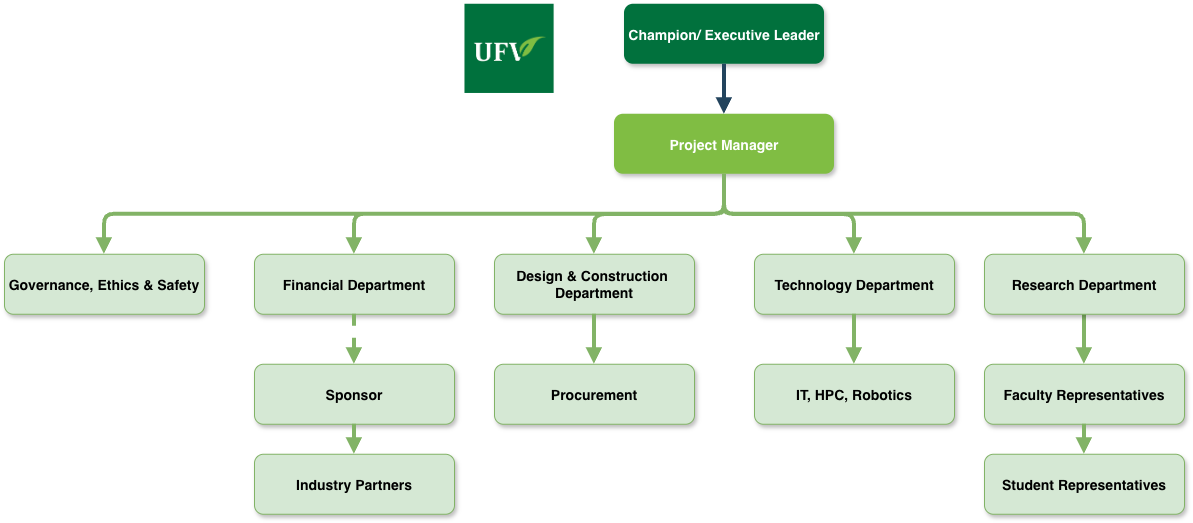
02 — Project Organization
The Project Manager mananges the 5 different departments.
Manages the three major project constraints: Scope, Time, Cost.
Manage budget, cost tracking, financial reporting and also find partnerships and potential sponsorship.
Handles architecture design, engineering and construction.
Will be in charge up buying HPC, GPUs, networking, cybersecurity and IT infrastructure.
Represent different faculties research requirements and will also adress student needs and usability.
Enforce guardrails covering Academic Intergrity, data privacy, transparency, fairness, accountability, and security standards.
03 — SWOT
The SWOT analysis shows potential strengths, weaknesses, opportunities, and threats for the project.
Internal · Helpful
Internal · Harmful
External · Helpful
External · Harmful
04 — Risk Register
Every major risk is planned out with a rate of severity and probability.
To overcome concerns about computing power footprint, integrate environmental aspects of public environmental scrutiny with public environmental contracts, on site solar supplementation, and liquid cooling infrastructure.
Multi-vendor supply chain procurement paths to be set up during Phase 1, and advance priority allocation to be given to specialized GPU architectures.
Create a dedicated reserve fund of $15M that is tied directly to the cost of the modular systems and only used for upgrades to the systems, with a frequency of 36 months.
Establish formal change control procedures, project management team must approve track of new hardware.
Conduct public outreach workshops to engage with local communities and address their concerns about AI taking jobs, showing how the centre is about collaboration with humans, upskilling workers, and economic development instead.
05 — Ethics & Sustainability
A facility at this scale needs its limits written down from the start.
Large scale data processing and machine learning workflows will be processed by ARIC and therefore a robust ethical governance structure will be embedded within the ARIC facilities. All research data will be kept in accordance with the BC Freedom of Information and Protection of Privacy Act [8]. In addition, the guidelines for use of the facility account for an ethical impact assessment of algorithmic biases, data sovereignty, and human-in-the-loop protection measures for each applied AI project.
It will be available to all UFV students in a variety of academic disciplines, and will be an open access facility, not just a facility for advanced research. Scheduling slots and collaborative spaces will be retained that allow for interdisciplinary involvement.